All Things Considered:
Was UN Radio A “Bar-Kulan” or “Bar-Lumis”?
News Excerpts
U.S. mind men tell Somalis about the weather
By Paul Holmes
December 20, 1992

MOGADISHU, Dec 20, Reuter - American mind men put a newspaper on the streets of Somalia on Sunday that tells locals about the U.S.-led armed intervention and -- in case they don`t know -- the weather.
“It`s hot and sticky. That must be the easiest job in Mogadishu, being the weatherman,” said Marine Colonel Fred Peck, explaining one of the features dreamed up by the U.S. military`s “psychological operations unit” to put in the daily Somali-language newspaper.
“Willard Scott doesn`t have to worry about any competition from here,” Peck said in a reference to the weatherman on NBC`s Today programme.
The single-sheet newspaper, called Rajo (Hope) as in Operation Restore Hope, was the latest product pumped out by the “psy-ops” unit for a largely welcoming population since the first Marines landed in Mogadishu on December 9.
Radio Rajo also began twice-daily 30-minute broadcasts of reports from the newspaper, said Peck, the U.S. military spokesman.
Five thousand copies of the newspaper were given away in Mogadishu, in Bali Dogle and Baidoa, and along the route of a food convoy which U.S. troops escorted from the capital to Baidoa.
The inaugural issue contained U.S. President George Bush`s policy statement on Somalia, as well as features on the relief effort for Somalia`s famine and the role of the U.S.-led forces.
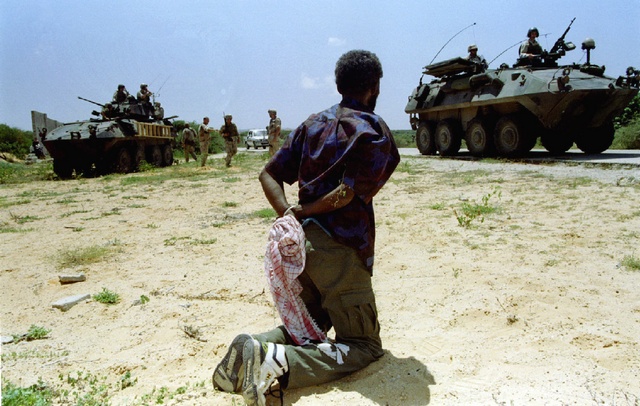
U.S. military commanders have made a point of stressing that the troops come as friends of Somalis rather than to fight them -- unless they are armed looters spoiling for a battle.
U.S. military vehicles fly the Somali flag of a white star on a light blue background as well as the Stars and Stripes.
Leaflets about the size of a dollar bill have also been dropped on towns where U.S.-led forces are about to move in, showing a helmeted Marine with an M-16 rifle shaking hands with an unarmed Somali.
Similar leaflets telling Iraqi troops how to surrender were dropped on Iraqi lines in Kuwait during the Gulf War.
Peck said Rajo would not cover foreign news and would appear only in Somali.
“It was part of the charter that the psychological operations unit that puts this out works under,” he said.
© 1992 Reuters Limited
UNITAF Radio Changes Names as UN Takes over International Operation
BBC Monitoring Service: Africa
May 07, 1993

(ME/1680 ii) Following the hand-over of the international operation in Somalia from the US-led Unified Task Force (Unitaf) to the United Nations Operation in Somalia (UNOSOM) on 4th May, Radio Rajo (Mogadishu) on 5th May changed its name to Radio Manta (Somali for Today). Radio Manta, which announced itself as “the voice of the United Nations Operation in Somalia” (Somali: halkani wa radio manta, codka haulgaladha qaramatha midhoobey, ee Somalia), announced that it would be broadcasting on 6170 kHz in addition to the 9540 kHz and 89 MHz (FM) used by Radio Rajo.
(Radio Rajo (Somali for Hope) began broadcasts in Somali from the US embassy compound in Mogadishu in January 1993. The radio was set up to explain the reasons behind Operation Provide Hope, the US-led humanitarian intervention in Somalia.)
© 1993 The British Broadcasting Corporation. All Rights Reserved.
U.N. Waging Propaganda War in Mogadishu Segment Number: 02 Show Number: 1153
All Things Considered
June 19, 1993

Maanta staff at UNOSOM Media Center including Affey and Sabah, Mogadishu, 1993.
Daniel Zwerdling reports on the U.N. attempts to gain the support of the Somali people. The U.N. has set up a radio station and is distributing a newsletter to tell the Somalis how the U.N. has helped them.
GUEST(S): TED BARNES, Media Director; Capt. DOUG MANN
U.N. Waging Propaganda War in Somalia
KATIE DAVIS, Host: United Nations troops continue to search for Somali clan leader Mohamed Farah Aidid today as 2,000 of his supporters demonstrated against the U.N. and its presence in the country. The other battle the U.N. is waging is one for the hearts and minds of the Somalis. As NPR`s Daniel Zwerdling reports from the capital, Mogadishu, the weapons are a newsletter and a radio station.
DANIEL ZWERDLING, Reporter: Radio Manta {sp}, the voice of the United Nations operation in Somalia, hits the airwaves seven times a day, six days a week; they shut down on the Muslim holy day of Friday. If you`re passing through Somalia, you might catch it on your shortwave dial.
{excerpt of radio broadcast}
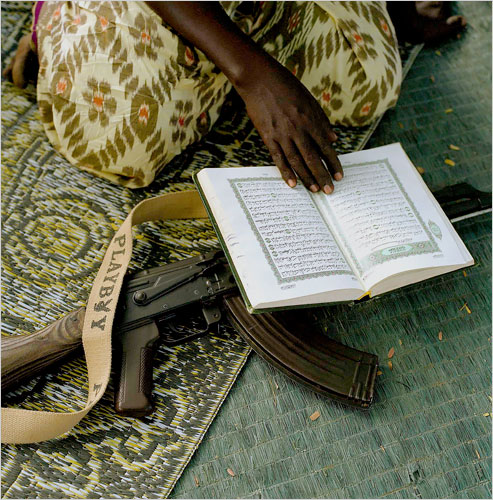
ZWERDLING: The U.S.-military officials who run the radio station say they don`t want to bludgeon people with propaganda - they want to have a program that appeals to the general population, so they start with some chanting from the Koran-
{sound of chanting}
ZWERDLING: -then they play popular Somali music. On today`s program, in fact, a musician who was pretty well known before the civil war recorded his pieces right there in the studio, 30 minutes before the show went on the air.
{excerpt of guitar music}
ZWERDLING: The musician told me he knows how to play all sorts of traditional instruments, but he said these days he performs only on his Somali guitar. Looters stole everything else he owned during the civil war. And finally, the radio announcer gets to the news.
[excerpt of newscast in foreign language]
ZWERDLING: On today`s U.N. broadcast, the newscaster leads with a U.N. general`s account of the attack earlier this week on Aidid`s headquarters. The report condemns Aidid`s forces as `brutal,` and hails the U.N. forces as `heroes.` But a couple days ago, the newscast reported that an American soldier had been charged with assaulting two Somalis. As psychological warfare goes, this is a pretty low-key operation. A few U.S. soldiers work with nine part-time Somalis knocking out stories on a word processor. Their radio studio is the size of a closet and when you hear the programs on the air, you hear the constant drone of an air conditioner going full blast just a few feet from the announcer, media director Ted Barnes {sp}.
TED BARNES, Media Director: We had to air condition in here back in April when we were- initially the U.N. came in and bought all the new equipment here and we would broadcast, and in a 45-minute broadcast, the machine would overheat, so we air conditioned in here, got a new amplifier and some other equipment, and since that time, we haven`t had that problem.
ZWERDLING: {interviewing} So, the air conditioner is on during the broadcast.
Mr. BARNES: It`s on during the broadcast.
ZWERDLING: {interviewing} Not exactly a soundproof hut.
Mr. BARNES: Yeah, this is not your, you know, your radio station back in Louisville, Kentucky, or Atlanta, Georgia. This is Mogadishu and we`re on the cheap.
ZWERDLING: It`s a tricky business figuring out exactly what kinds of messages will appeal to a given population, whether you`re talking about commercial advertisements or psychological warfare, and in this case, U.S. soldiers say, they realize they face an extra-tough sales job because a lot of their audience supports the enemy, warlord Mohamed Aidid. So, they`re experimenting. Earlier today, I found Captain Doug Mann {sp} working on a piece for tomorrow`s newsletter - a Somali version of the children`s story, `The Little Red Hen.`
{interviewing} Have you ever written children`s stories before this assignment?
Capt. DOUG MANN: I`ve written them, I`ve told them - I`ve got six kids.
ZWERDLING: In case you don`t have any kids and forget the first grade, the story is about a hen who asked her neighbors to help bake bread, but they all refuse to chip in, so when the bread`s finished, the hen refuses to share it. Mann says he`s ending this version of the story by pointing out that Somalis can`t enjoy peace unless they all cooperate.
Capt. MANN: You can`t sit by and let everybody else do the work for you. Everybody has to contribute to the peace. Now`s the time to step forward and do what`s right and what`s just and turn in the weapons so that Mogadishu can again return to peace. We have had some success with it, but not as much as we`d like.
ZWERDLING: Meanwhile, another soldier is writing tomorrow`s cartoon strip. The cartoon, which appears every day, is about a young man and his wise, philosophical camel who`s always doing and saying sensible things. In today`s cartoon, the camel says, `We thank Allah for what the United Nations is doing for us. The roads are now clear and we can travel freely.` - statements which many people here find to be exaggerated. The Americans running the media operation say their sense is that both the newsletter and radio show are popular all over Mogadishu. When I made a brief survey amongst Somalis standing along the street, I did not hear the same enthusiasm. Some told me they don`t listen to a word of the broadcasts because it`s all American and U.N. lies. One woman told me she reads the newsletter, not so much because she likes its, but because all the other newspapers went out of business during the civil war. At least the United Nations news, she said, is better than nothing. I`m Daniel Zwerdling in Mogadishu.
[The preceding text has been professionally transcribed. However, in order to meet rigid distribution and transmission deadlines, it has not been proof-read against audio tape and cannot, for that reason, be guaranteed as to the accuracy of speakers` words or spelling.]
© Copyright 1993 National Public Radio. All Rights Reserved.
United Nations to Provide a “Common National Radio”
BBC Monitoring Service: Africa
December 17, 1993

Maanta ceremony including Mr. George Bennett, the head of the news operation, Mogadishu, 1993.
Excerpts from report from UNOSOM radio
Following the outbreak of civil war in Somalia many radio stations appeared, some of them at district and regional levels. This was as a result of every [word indistinct] setting up its own station...
The Somali nation needs a common national radio. Enough is enough. We can no longer tolerate the aggressive and cheap propaganda broadcast by other Somali radios which speak daily in our country, said a Somali national who was very much annoyed by this. He added that we should express our confidence once again and live like human beings, while safeguarding the dignity and [word indistinct] of our people. He added this while talking about the radio station, which, it was hoped, would open soon and be called Radio of the Republic of Somalia or Radio Somalia, and which had been promised by UNOSOM. He concluded with an appeal to Somali people to wait and never to tire of their radio station which they would hear soon, that is, Radio Somalia.
Source: Radio Manta, Mogadishu, in Somali 1300 gmt 15 Dec 93
© 1993 The British Broadcasting Corporation. All Rights Reserved.

Maanta staff including Affey, Mogadishu, 1993.
New Somali radio denies it is “mouthpiece of international organizations”
Monday, March 1, 2010
Text of “Message from the Director of Bar-Kulan” posted in English on the website of Somali Bar-Kulan Radio on 27 February
Bar-Kulan test transmissions are beginning this Monday (1 March) at 0500 UTC (gmt) (8 a.m. in Somalia). It is a very exciting time for Somali-language radio. A dedicated team of Somali journalists has been working hard to bring to you credible, independent programming about, for and by Somalis.
Bar-Kulan speaks with its own voice. Editorial independence is its bedrock. Bar-Kulan is answerable only to the people who produce its content and the people of Somalia and its Diaspora.
As with any new media outlet, the rumour mill runs rampant before the first broadcasts have hit the airwaves. We have even received reports of people listening to our programmes before the transmitter has been switched on!
The most prolific rumour circulating about Bar-Kulan is that it is the mouthpiece of international organizations based in Mogadishu - this is absolutely NOT TRUE (upper-case as published). Bar-Kulan invites all who are interested in the peace, safety and prosperity of Somalia to take part in what it is doing. The discussion table is open to everybody, and monopolized by nobody.
Welcome to the home of independent Somali thought and information. Welcome to Bar-Kulan. Everywhere.
Bar-Kulan Radio.
(For more details of this new station, see the BBC Monitoring feature published on 26 February: New UN-backed, Somali-language Bar-Kulan Radio prepares to launch)
© Compiled and distributed by NTIS, US Dept. of Commerce. All rights reserved.