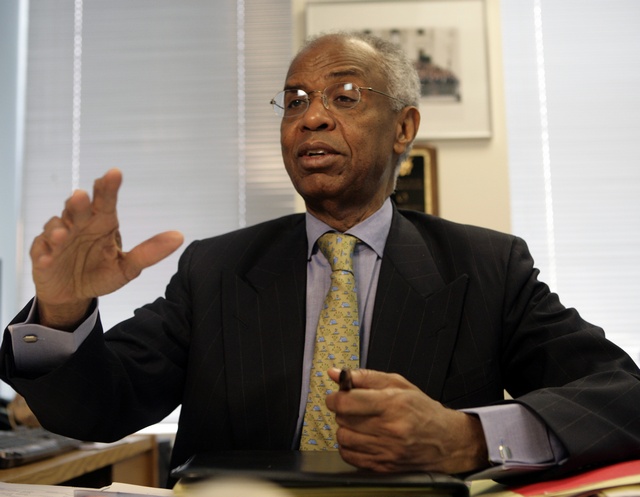
Sheik Tantawi, 81, Egypt`s religious chief
By Michael Slackman
International Herald Tribune
March 11, 2010

Officials carry the coffin of Sheikh Mohamed Sayed Tantawi, the head of Egypt`s most prestigious seat of Islamic learning al Azhar, at King Khalid International Airport in Riyadh March 10, 2010. Tantawi died of a heart attack on Wednesday during a visit to Saudi Arabia, religious officials at al-Azhar said. Riyadh March 10, 2010. REUTERS/Fahad Shadeed (SAUDI ARABIA)
Sheik Mohamed Sayed Tantawi, Egypt`s chief religious official and leader of Al-Azhar University, the oldest and most prestigious center of learning in the Sunni Muslim world, died Wednesday on a visit to Saudi Arabia, the Egyptian state news media reported. He was 81.
The cause appeared to be a heart attack, according to the Middle East News Agency. His death was confirmed in a statement by Al-Azhar.
For more than a quarter-century Sheik Tantawi was at the nexus of government and religion in Egypt, working with President Hosni Mubarak`s government to try to enforce a moderate interpretation of Islam. But his pro-government decisions, authoritarian ways and willingness to deal with Israelis made him a divisive figure from the moment Mr. Mubarak appointed him sheik of Al-Azhar in 1996.
“He preserved the moderate nature of Azhar despite the rise of the extreme current within it,” said Salah Eissa, editor of Al-Qahira, a weekly newspaper published by the Ministry of Culture.
But while Sheik Tantawi`s religious decisions often put him in the moderate camp at a time of fundamentalist revival, he was also criticized by liberals and conservatives in Egypt as appearing to grant religious legitimacy to government.
Fundamentalists often denounced his decrees, like a recent effort to ban female university students from covering their faces with a niqab, or veil. Nearly everyone here, it seemed, attacked him for granting religious justification for the decision to erect a steel barrier on the border with the Gaza Strip to prevent smuggling. In 2008, he was criticized for shaking hands with Shimon Peres, the Israeli president, at a conference in New York, but he later said he had not realized who Mr. Peres was.
“You can say he was moderate, but for me the problem is he was very politicized and very governmental,” said Ali Mabrook, a professor of Islamic studies at Cairo University. “Al-Azhar under his leadership became very politicized.”
Before taking over the leadership of Al-Azhar, Sheik Tantawi served for 10 years as Egypt`s grand mufti, heading the House of Fatwa as the nation`s chief arbiter of religious law. As sheik of Al-Azhar, he oversaw a sprawling institution with influence around the world.
In Egypt, the government is effectively required to obey Al-Azhar`s rulings over which books and films must be banned. It runs a university system with more than 300,000 students and an elementary-through-high-school system that serves 1.5 million students. It sends hundreds of religious scholars into Africa and Asia to promote the faith, and there are more than 30,000 foreign students studying in its schools at any one time.
At Al-Azhar and earlier as grand mufti, Sheik Tantawi often seemed surprised, but unmoved, by the volatile reaction his decisions provoked.
“He was short-tempered and abrupt in his reactions sometimes,” said Mr. Eissa, the newspaper editor. “He was also aggressive in his relationship with the media. There are stories about him kicking out reporters he thought were asking him questions with bad intentions.”
But, Mr. Eissa said, “he held a lot of views that were considered to be enlightened at a time when the extremist religious tide is rising in Egypt and the Muslim world.”
Sheik Tantawi was repeatedly challenged by the so-called traditionalist scholars, who wanted Egypt run more according to Sharia, Islamic law. He was appointed after the death of his predecessor, Sheik Gad al-Haq, a favorite of conservative religious scholars, who saw their power and independence grow under his leadership.
To the West, he often appeared a moderate. He condemned the Sept. 11, 2001, terrorist attacks and criticized the practice known as female genital mutilation, which is common in Egypt. At home, he was accused of not being aggressive enough in defense of Muslims around the world, as when he refused to criticize a French decision to ban Islamic head scarves and other religious symbols in public schools.
Egyptian news agencies said Sheik Tantawi`s body was being flown for burial to Al-Madinah al-Munawarah, the second-holiest city in Islam and the burial place of the Prophet Muhammad.
© 2010 The New York Times Company. All Rights Reserved.
Egyptian leader receives condolences over death of Shaykh of Al-Azhar
MENA Online
Wednesday, March 10, 2010
Cairo, 10 March: Egyptian President Husni Mubarak received on Wednesday several cables of condolences from Arab leaders over the death of Grand Imam of al-Azhar Shaykh Mohammad Sayyid Tantawi, who passed away earlier in the day.
Kuwaiti Emir Shaykh Sabah al-Ahmad al-Jabir al-Sabah, Kuwaiti Crown Prince Shaykh Nawaf al-Ahmad al-Jabir al-Sabah and Prime Minister Shaykh Nasir al-Muhammad al-Jabir al-Sabah sent cables of condolences to the president.
Also, Palestinian President Mahmud Abbas sent a similar cable to the Egyptian president and people on the same occasion.
President Abbas entrusted a top-ranking delegation, to be led by Minister of Awqaf (endowments) and Religious Affairs Mahmud al-Habbash, to take part in the funeral procession.
Also, (Coptic Orthodox) Pope Shenudah of Alexandria and Patriarch of St. Mark Diocese regretted the demise of the late Grand Imam.
Meanwhile, Safwat al-Obaidi, the head of the Egyptian Anglican sect sent a similar cable.
The Palestinian Islamic Resistance Movement Hamas also sent a cable of condolences to the Egyptian people and leadership over the death of Sheikh Tantawi. The ISESCO sent a similar cable. Also, Lebanese Shiite cleric Mohamed al-Haj Hasan sent a cable of condolences on the occasion.
(At 1244 gmt, Mena published that Al-Azhar institute on Wednesday announced to the Islamic world the death of the Grand Imam of al-Azhar Shaykh Muhammad Sayyid Tantawi in Riyadh earlier in the day.
Al-Azhar was quoted as saying that “the Islamic and Arab world lost a reverend cleric and a great scholar of Islam”. At 1241 gmt, Mena said that the Speaker of the Egyptian People`s Assembly, Ahmad
Surur, “regretted the death of Grand Imam”. “The late great scholar has had many contributions in the service of Islam,” Surur was quoted as saying in a statement.
At 1406 gmt, Mena published that Shaykh Ali Jom`ah, in a message from Japan, mourned the deceased “who dedicated his life in the service of Islam”. Jom`ah said: “The late Imam was an icon and a symbol of moderate Islam.”)
(Description of Source: Cairo MENA Online in English -- Government news agency; URL: http://www.mena.org.eg)
© Compiled and distributed by NTIS, US Dept. of Commerce. All rights reserved.
Rapprochement between Sunni, Shi`i Muslims necessity - Egypt grand imam
MENA Online
Saturday, February 27, 2010
Cairo, 27 February: Al-Azhar Grand Imam and President of the Islamic Research Academy (IRA) Dr Muhammad Sayyid Tantawi said any Muslim person who insists on slandering any of Prophet Muhammad`s companions (Sahaba) is an apostate.
Islam separates itself from those offenders, Tantawi said Saturday (27 February) at the opening of 14th IRA conference, which is held under the theme “Companions of the Prophet Muhammad (PBUH)”. He stressed the importance of learning lessons from the Prophet`s companions` lives to achieve the development and growth of the Islamic nation. Rapprochement between Sunni and Shi`i Muslims is a necessity to unite the Islamic nation, he added.
Egypt`s Grand Mufti Ali Jum`ah and IRC members from Muslim countries are participating in the event.
(Description of Source: Cairo MENA Online in English -- Government news agency; URL: http://www.mena.org.eg)
© Compiled and distributed by NTIS, US Dept. of Commerce. All rights reserved.
Kuwaiti MP Criticizes Al-Azhar`s Chief Over `Bizarre` Fatwa Banning Face Veil
Kuwait Times
Friday, October 9, 2009
Unattributed report: “Hayef Blasts Tantawi Over Niqab Comments”
A Kuwaiti hardline Salafist MP yesterday blasted Egypt`s leading cleric Mohammed Tantawi for reportedly saying that wearing a face veil was not an obligation under Islam for women. “Tantawi`s statements against the niqab (face veil) are shameful,” Mohammad Hayef told reporters. “He is known for his bizarre and abnormal fatwas (religious edicts).
Tantawi, head of the Islamic Al-Azhar University, told a schoolgirl to remove her niqab when he spotted her during a tour of an Al-Azhar affiliated school, the independent Al-Masry al-Youm newspaper reported this week. He also said he intended to ban the niqab at Al-Azhar and made an unflattering remark about the girl`s appearance when she took off the veil, the newspaper said. “And you look like this; what would you do if you were a bit pretty,” he reportedly asked, adding “I know more about religion than your parents.
Meanwhile in Egypt, an Islamist lawmaker called yesterday for Tantawi to resign. The demand to step down came as about two dozen students, wearing the niqab, protested outside the state-run Cairo University, which has banned the veils from its residence hall. Al-Azhar spokesman Ahmed Tawfiq confirmed Tantawi had asked the girl to remove the niqab, but said he spoke to her in a kindly way. He said Tantawi, who insists the niqab is not an Islamic practice, wanted to ban the niqab from Al-Azhar classrooms on religious grounds. “The imam always bases his decision on religious grounds,” said Tawfiq.
Hamdi Hassan, an MP with the Muslim Brotherhood, Egypt`s largest opposition group, said “Tantawi cannot stay in his post; he hurt`s Al-Azhar every time he says something. “I believe the niqab is not an obligation, but it is a benefit,” he added. “Why ban it from Al-Azhar? It`s a religious institution, not a belly dancing academy.
Meanwhile, about two dozen students wearing the niqab, which covers all but the eyes, gathered outside the gates of Cairo University`s residence to protest at the decision, their luggage piled on a nearby pavement. “I have exams in two weeks. I haven`t found a house and I can`t study,” said one student who gave her name as Fatin. “What happened to individual freedom? Cosmetics are freedom, but not the niqab?
Most Muslim women in Egypt wear the hijab, which covers the hair, but the niqab is becoming more popular on the streets of Cairo. The government has shown concern over the trend. The religious endowments ministry issued booklets against the practice, saying the niqab is not Islamic, and the health ministry wants to ban it among doctors and nurses.
In the Middle East, the niqab is associated with Salafism, an ultra-conservative school of thought practiced mostly in Saudi Arabia. Most Salafis shun politics, but the creed has influenced Islamist militants such as Al-Qaeda chief Osama Bin Laden. Al-Azhar has long enjoyed a reputation as Sunni Islam`s eminent source of learning and edicts. Salafis, who actively promote their creed, sometimes funded by wealthy patrons in Saudi Arabia, are opposed to Al-Azhar`s theological teachings.
(Description of Source: Kuwait Kuwait Times Online in English -- Website of large-circulation, independent, pro-government daily; URL: http://www.kuwait-times.com/)
© Compiled and distributed by NTIS, US Dept. of Commerce. All rights reserved.
Egypt:: Al-Azhar Shaykh on Role of Al-Azar in Anti-Terrorism, Social Reform
Al-Sharq al-Awsat
Sunday, December 23, 2007
Interview with Al-Azhar Shaykh Dr Muhammad Sayyid Tantawi, by Muhammad al-Shafi`i, from London: “Al-Azhar Shaykh Muhammad Sayyid Tantawi: Terrorism Is a Religious Catastrophe and a Worldly Catastrophe”
Dr Muhammad Sayyid Tantawi, Al-Azhar Shaykh, has said that fraternity of all human beings is one of the basic facts of the general Islamic tendency. He points out that the Holy Koran stresses the wisdom of agreeing, cooperating, and meeting on charity and piety among all individuals and peoples.
In an interview with Al-Sharq al-Awsat at the Egyptian embassy in Central London Dr Tantawi said: Islam stresses that there is no coercion in religion, because coercion produces only liars and hypocrites. He said that every country has its civilization, culture, and history; “We do not believe in the clash of civilizations, but in their meeting and cooperation. The east has its civilization, and the west has its civilization, and the rational men are the ones who learn from each other.”
Dr Tantawi talked about the misguided groups and the destructive groups gnawing at the society. He talked about terrorism, and Islam`s stance toward it. He stressed, “The world contains good and evil, people differ in their thinking and ideologies, and our duty is to support what leads to good and piety, and to forbid what leads to evil and corruption.” The Al-Azhar Shaykh said: “God Almighty has given the human beings the mind to distinguish between right and wrong; reason always calls for the virtues to which we ought to commit, such are truthfulness and justice, and forbids aggression, injustice, terrorism, and other vices.” He stressed, “The ulema are responsible for spreading this among the people.”
The Al-Azhar Shaykh started his interview by praising Al-Sharq al-Awsat, which he called a serious international newspaper. The following is the text of the interview:
(Al-Shafi`i) Where is the role of Al-Azhar in guiding and directing the misguided groups whose members are arrested by Egyptian security, such as those arrested recently: the group of Ethiopians that calls for praying without ablution and for acquiring blessings from mausoleums, and another group that calls for violence?
(Tantawi) Since God created the human beings there have been rational men and fools, followers of the truth and followers of the false. There are those who see the truth as false, and those who see what is false as true. God Almighty has given the human beings the mind to distinguish between right and wrong; reason always calls for the virtues to which we ought to commit, and forbids aggression, injustice, terrorism, and other vices. The ulema are responsible for spreading this among the people. The world contains good and evil, and our duty is to support what leads to good and piety. These groups are against Islam and Muslims; if they said that prayers could be performed without ablution, they would be ignorant, very ignorant. Any prayer without ablution, even using clean sand if water was not available, would be invalid; this is agreed unanimously by all Muslims. As for the groups that call for violence in any shape or form of aggression, they are sinful at heart, ignorant, and are not worthy of listening to what they say; moreover, our duty is to rebut their claim.
(Al-Shafi`i) What has Al-Azhar done in order to modernize itself?
(Tantawi) Al-Azhar, as a religious institution and a university, has a mission to explain what is right and what is wrong, explain what leads to the happiness of the society, and explain the harm done to society by any diseases that are inflicted upon it. Al-Azhar receives the boy and girl pupils when they are four-years old at the preschool or kindergarten stage, then for six years at the primary school; during these six years the pupil memorizes 18 parts of the Holy Koran; after that the pupil goes to the preparatory stage for three years in which he or she memorizes seven other parts of the Holy Koran. This means that by then the pupil would have memorized 25 parts of the Holy Koran. In the secondary stage the pupil memorizes five parts of the Holy Koran, i.e. the pupil would have memorized 30 parts before entering Al-Azhar University. The pupil does not enter the Al-Azhar University unless he has memorized the entire Koran. This is in addition to the relative expansion of shari`ah sciences, such as jurisprudence, interpretation, and Hadith; also the relative expansion in linguistic science, such as grammar, literature, and rhetoric. As for the other sciences, such as mathematics, chemistry, and physics, Al-Azhar students are taught the same as the students of general education. In Al-Azhar University there also are colleges for medicine, engineering, shari`ah, and languages; there are 70 colleges within Al-Azhar University. The mission of Al-Azhar is to explain to the people that terrorism is a religious catastrophe and a worldly one, good ethics ought to prevail over the Muslim nation, vices ought to be fought and destroyed, the Islamic callers and Al-Azhar graduates ought to explain to the people the need to cooperate to make the nation happy. Al-Azhar graduate is stronger in his field and specialty than other university graduates. There are branches of knowledge in which the Al-Azhar student ought to be distinguished, such as memorizing the Holy Koran, the shari`ah knowledge and linguistics. This is because of the relative expansion in the shari`ah knowledge, such as jurisprudence, Hadith, and interpretation, as the Al-Azhar student receives some 6 lessons of jurisprudence every week; also there is expansion of linguistic sciences, such as grammar and rhetoric.
(Al-Shafi`i) How did the problems and diseases we see today in the Egyptian society, such as common-law marriage, emerge despite the existence of a large number of Islamic callers, and a larger number of Al-Azhar graduates in Cairo and in the other cities?
(Tantawi) The problems of society also appeared during the days of the prophets and the reformers. The Islamic callers ought to show, direct to, and explain the right and the wrong, and the good and the evil. However, a reformer cannot change the souls. The religious institution, over which I have the honor to preside, can only advise, but cannot prevent; I cannot muzzle people. The role of the media here is important in explaining the dangers and diseases that threaten the society. My role is not the role of policeman; if I were to interfere and to call for a ban, the media and its representatives would be boiling, and would say: Where is the freedom of opinion?
(Al-Shafi`i) Why have you not intervened to bring closer the Palestinian factions fighting over government?
(Tantawi) Day and night we say to them: O our brethren in Palestine; abandon conflict and dispute, because this dispute will not lead you to the result you want. I cannot do more than this. The initiative, in the sense of advice, to HAMAS and Fatah is issued nearly on a daily basis. However, do I have the power to make everything I say be implemented?
(Al-Shafi`i) What is your stance toward the jurisprudence revisions of the Egyptian Jihad Group? Have you had any role in issuing them? Some of the revisions pointed out the negligence of Al-Azhar in guiding and directing the youths away from violence?
(Tantawi) No one submitted these revisions to us, and we were not consulted about them. As for the claims of Al-Azhar negligence, these are not true as a whole, because Al-Azhar has not shown any neglect in teaching the memorization of the Koran and the Islamic virtues to those affiliated to it, or in teaching the youths what is admissible and what is not from a shari`ah point of view. The Islamic callers have not shown any neglect in their call for abandoning violence, and cooperating in charity and piety, or in stressing that sabotage, whatever its color or source might be, is not approved by Islamic shari`ah, which fights anyone who is a destructive element in the nation, whether this destruction is through false pronouncements or through lying and false rumors. If there were any negligence, perhaps it is by individuals. To generalize a judgment in this way is wrong; for instance, I cannot say that all Islamic callers are excellent, but I can say that there are those who are excellent, others are good, a third group are acceptable, and there are some who are weak.
(Al-Shafi`i) Is your visit to London linked to visiting Shaykh Muhammad al-Salamuni, the Imam of Regent Park mosque, who was exposed to a racial assault?
(Tantawi) Basically, I came to London at the invitation of Ambassador Jihad Madi to visit Shaykh Al-Salamuni to get reassured about his health. I told Egyptian Ambassador Jihad Madi that the program of my visit to the British capital would be based on getting reassured about our colleague, Shaykh Al-Salamuni, who lost his sight as a result of this assault. I can feel the interest of the president of the republic, the government, and Al-Azhar in the condition of Shaykh Al-Salamuni. Thankfully, the state, represented by President Mubarak, commissioned Prime Minister Dr Ahmad Nazif immediately after the incident and in the same day of the assault to carry out the treatment of Shaykh Al-Salamuni at the expense of the state, and in the best British hospitals. We all are exposed to dangers wherever we are, and the state does not neglect us. We will not abandon Shaykh Al-Salamuni under any circumstances. Even when some non-Egyptians offered to do so (pay for the treatment), Shaykh Al-Salamuni said that the Egyptian State did the necessary. We thank those who volunteered and those who would like to volunteer to help. I have found Shaykh Al-Salamuni to be dignified, patient with the calamity, and in high spirits despite the fact that he lost his sight completely, which is something that is more valuable than any financial funds. I have asked Shaykh Al-Salamuni to do his duty in his mission in London as much as he can, and agreed that with Dr Ahmad al-Dubyan, director of the Islamic Cultural Center in London. I will visit Shaykh Al-Salamuni tomorrow before I travel back to Cairo.
(Al-Shafi`i) What is your opinion of the Al-Misyar marriage (traveler`s marriage)?
(Tantawi) When I went to the Kingdom of Saudi Arabia, I asked the brother well-established ulema about the meaning of the travelers marriage. They said to me verbatim: If a woman became widowed, had children whom she wanted to bring up, and her husband left her a dwelling and sufficient money for her and her children, but if she also were young, and someone asked for her hand in marriage, while she did not want to leave her children or house, she could accept the marriage on condition that she would remain in her house after the shari`ah marriage and the payment of the dowry. She could say to the man: I will not cost you much money, but it is enough for me that you visit me once or twice a week, because when I have a husband I will be protected by this husband, and I will protect myself and my honor, because I am a woman who likes what women like. This is the traveler`s marriage, which is a shari`ah marriage, and there is nothing wrong with it if it were performed in this way.
(Description of Source: London Al-Sharq al-Awsat (Internet Version-WWW) in Arabic -- Influential Saudi-owned London daily providing independent coverage of Arab and international issues; editorials reflect official Saudi views on foreign policy. URL: http://www.asharqalawsat.com/)
© Compiled and distributed by NTIS, US Dept. of Commerce. All rights reserved.